# 4.4 for 迴圈
while 和 do...while 迴圈很適合用在「你知道什麼條件下迴圈要繼讀或停止」,因為決定是否再繞一圈的就是一個條件判斷式。
但是在你很清楚一共要繞幾圈的情況下,使用接下來介紹的 for 迴圈,會輕鬆很多。
## for 迴圈
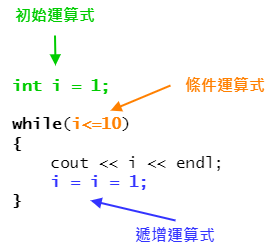
使用 while 迴圈來繞指定圈數,我們多採用這樣的架構,其中變數 i 擔任計數器,我們會:
1. 指定計數器的初始值
2. 每圈檢查計數器的值是否仍符合條件
3. 每圈遞增計數器的值
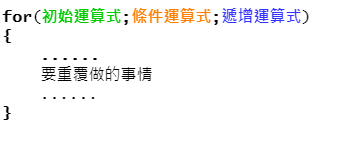
for 迴圈可以一次搞定這三者。
### for 的基本語法
以輸出 1~10 為例,程式看起來比較簡潔,而且還是很清晰。
###### 練習:輸出 1 ~ 10
```C++
for(int i=1; i<=10; i=i+1)
{
cout << i << endl;
}
```
1
2
3
4
5
6
7
8
9
10
###### 練習:輸出 n 的所有正因數
因為 n 的所有正因數是 1~n 之間的整數,所以我們用一個 for 迴圈來遍歷整個區間做篩選。
```C++
int n = 16;
cout << n << "的正因數有:";
for(int i=1; i<=n; i++)
{
if(n%i==0)
{
cout << " " << i;
}
}
cout << endl;
```
16的正因數有: 1 2 4 8 16
## 變數的生命週期
輸入以下這段程式後編譯執行,在編譯時期就會發生錯誤。
```C++
#include
using namespace std;
int main()
{
for(int i=1; i<=5; i++)
{
cout << i << endl;
}
cout << "now i=" << i << endl;
return 0;
}
```
12:25: error: 'i' was not declared in this scope
cout << "now i=" << i << endl;
^
錯誤訊息表示在 12 行那邊使用到變數 i 但是沒有宣告。但是你往上看會覺得「明明我在第7行,for 迴圈那裡一開始就宣告了啊」。
仔細看一下錯誤訊息第一行末的 - "in this scope",他是說你沒有在這個 scope 裡宣告 i。這個 scope 是什麼意思呢?
我們來看一下這個程式:
```C++
#include
using namespace std;
int main()
{
{
int i=5;
cout << "1: i=" << i << endl;
i=i+1;
}
cout << "2: i=" << i << endl;
return 0;
}
```
第 8, 9, 10 行被放在一組大括號裡,整個大括號範圍可以視為一個程式區塊(block)。這個區塊算是一個 **區塊範圍(block scope)**,宣告在這個區塊裡的變數屬於 **區域變數(local variable)**,該變數的生命週期始於宣告完成,終於離開區塊。
所以在第 8 行開始,到第 11 行結束的範圍內,都可以存取變數 i 的值。但是在第 12 行開始,或第 7 行之前,都看不到也無法存取這個變數 i 的值。
試著編譯並執行這個程式,你會發現第 9, 10 行存取 變數i 都沒有問題,但是第 13 行會發生編譯錯誤,編譯器會抱怨 變數 i 沒有在這個 scope 裡宣告。
若是把大括號拿掉,變成這樣。
```C++
#include
using namespace std;
int main()
{
int i=5;
cout << "1: i=" << i << endl;
i=i+1;
cout << "2: i=" << i << endl;
return 0;
}
```
現在整個程式只剩下一個 block,即第 6 ~ 14 行。所以變數 i 的生命週期始於第 7 行,終於第 14 行。程式輸出結果如下。
1: i=5
2: i=6
for 敘述(包含整個大括號範圍)也是一個 block scope,所以如果我們在 for 裡面宣告變數,它的生命週期也只限於該 for 迴圈內。
一般來說若只是單純用於迴圈的計數器,我們會像這樣把它宣告在 for 敘述裡。
```C++
for(int i=1; i<=5; i++) // 宣告在 for 敘述裡面
{
......
}
```
若是該變數在迴圈結束之後還有用處,我們會把它宣告在 for 迴圈的外面。
```C++
#include
using namespace std;
int main()
{
int i; // 宣告在 for 敘述外面
for(i=1; i<=5; i++)
{
cout << i << endl;
}
cout << "now i=" << i << endl;
return 0;
}
```
1
2
3
4
5
now i=6
關於 scope 的詳細說明,有興趣的話可以先看一下這份文件 - [scope](https://en.cppreference.com/w/cpp/language/scope)。以後我們會另外開一個主題做更全面的討論。
## Online judge 讀取 n 筆測資
在競程的題目中,有一種測資型式是這樣的。
**輸入說明:**
輸入的第一行有一個整數 t。接下來的 t 行每行有一個正整數 y,代表西元年份。
**範例輸入:**
4> year;
// do something
}
```